One sensor, one model, one instruction.
V3LA is a closed loop: a device that measures circadian phase continuously, a model that infers where your internal clock actually sits, and an app that turns that estimate into three or four decisions a day. Everything below is one of those three parts.
V3LA One
A titanium ring with no screen, no haptics and no optical heart-rate sensor. Dropping PPG is what buys the battery life and the thermal stability — and PPG was never the signal we needed.
Two thermistors sit against the finger with a known thermal path to ambient, so we can separate a genuine drop in distal temperature from a cold corridor. A 6-axis IMU supplies rest-activity and, at night, an HRV proxy from ballistic motion.
The estimator is the product.
Anyone can plot a temperature curve. The hard part is inferring phase from a signal that is contaminated by ambient temperature, activity, alcohol, illness and the fact that people take rings off. Three things make it work.
Personalised oscillator
A limit-cycle model with per-user amplitude and intrinsic period, fit by particle filter. Your τ is not 24.0 hours and the model doesn't pretend otherwise.
Light history
Phase response to light is nonlinear and direction-dependent. We integrate ambient exposure from the phone and treat it as the primary control input, not context.
Honest uncertainty
Every estimate ships with a confidence interval, and the app says less when the interval is wide. Silence is a feature in a product people trust with a night shift.
On-device inference
The whole loop runs on the phone in under a second. Nothing needs to leave the device for the product to work, which also settles most of the privacy conversation.
Plans, not dashboards
You give V3LA your roster once — typed, imported from a calendar, or pulled from a workforce system. From then on the app works backwards from each shift to the decisions that change how it feels.
Vela, on your phone
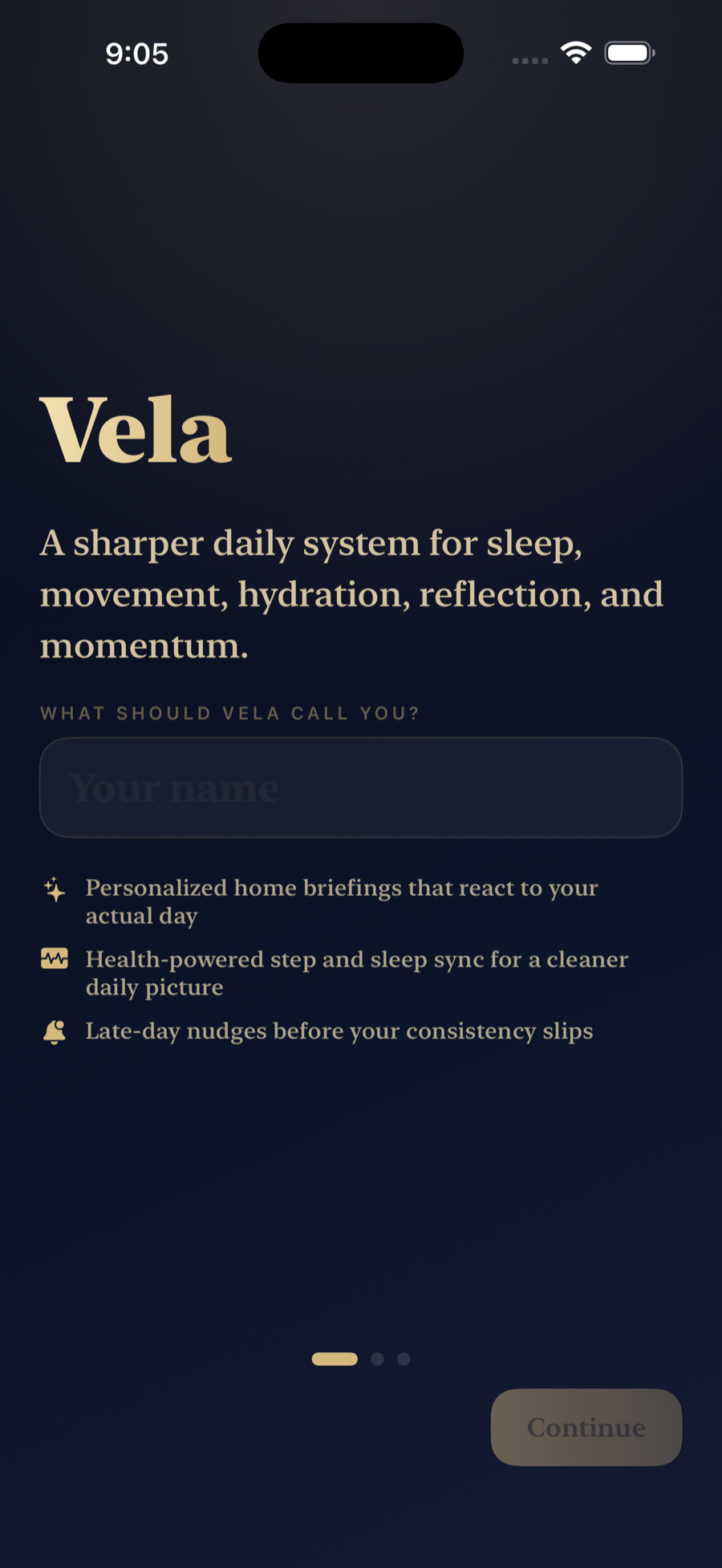
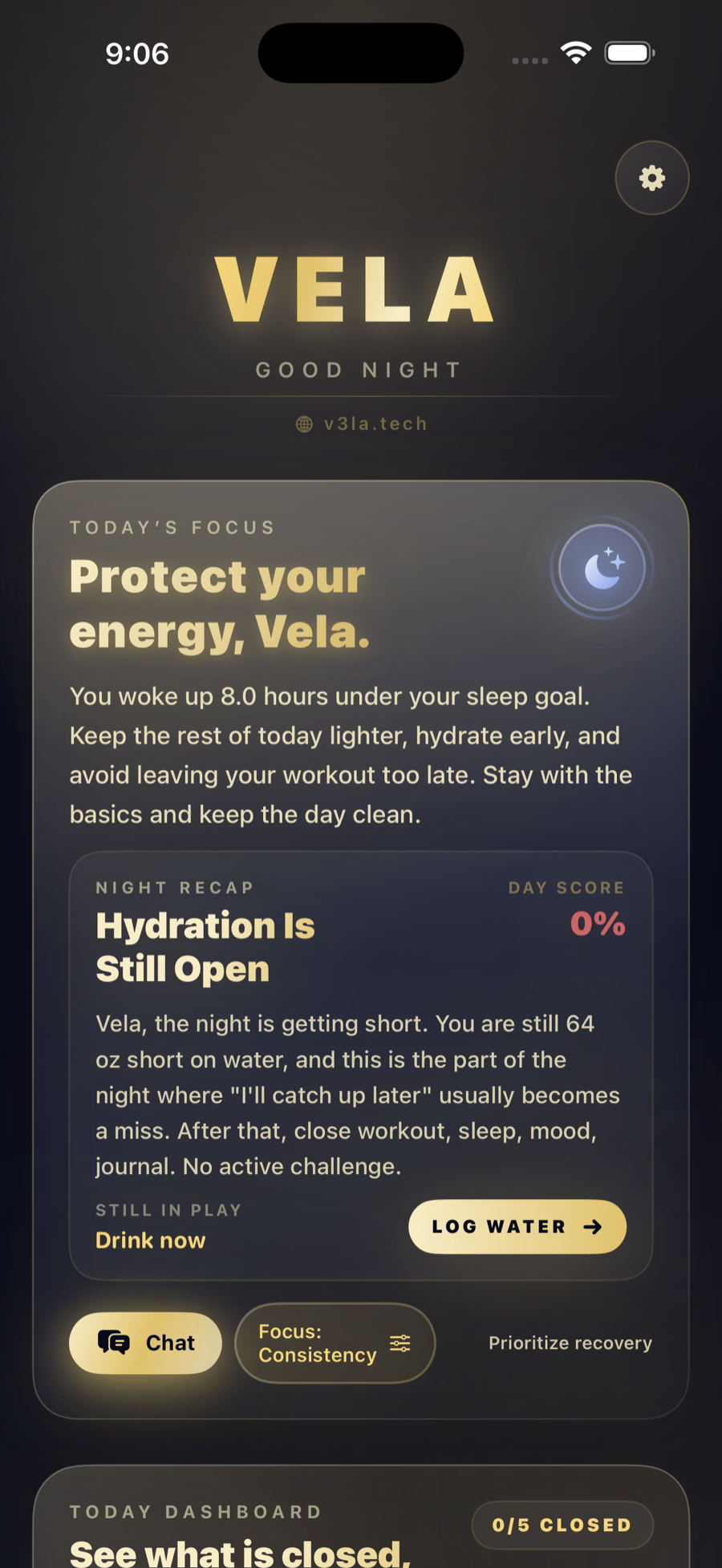
Vela is the V3LA app — the interface for everything above. Onboarding is one screen: a name and three lines on what it does. From there it reads your day back to you each morning and night, in plain language, with one thing to act on.
Health-app sync pulls sleep and steps in automatically. When something is slipping — hydration, a workout pushed too late — Vela says so before it becomes a missed day, not after.
Integrations
Reads sleep and workouts, writes phase-adjusted sleep windows back.
Any roster that publishes a feed becomes a schedule V3LA can plan against.
Kronos and Workday connectors for enterprise deployments, read-only.
Raw 1 Hz series and phase estimates as CSV for collaborating labs.
See the evidence behind it.
Validation methods, pilot results and the phase-estimation error we publish against.